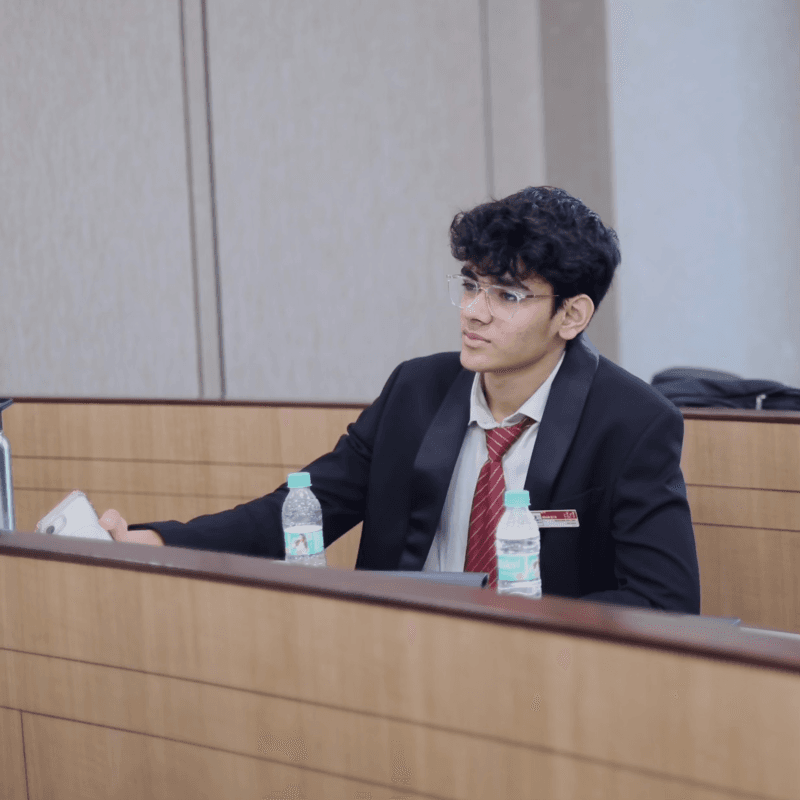
Arham Sethi
IEEE CIBCB 2026
Agricultural AI
Computer Vision

Arham Sethi

The Shishukunj International School
Indore, India

Built WERM — a novel framework for predicting weed emergence risk from field imagery and thermal data. Published at IEEE CIBCB 2026 in Greece, one of the largest computational biology conferences in the world.

IEEE
IEEE CIBCB 2026
IEEE Conference on Computational Intelligence in Bioinformatics and Computational Biology — Greece

Where Arham Started

His Background

  • • 11th grader at The Shishukunj International School, Indore
  • • Self-taught AI/ML since age 13, sparked by first encounter with ChatGPT
  • • Already researching robust CNNs for real-world image conditions
  • • Presented at Young Scientist India national science fair
  • • Strong Python and deep learning experience
  • • Interested in using AI for satellite/drone imagery analysis

His Goals

  • • Publish a peer-reviewed research paper
  • • Win a science fair competition
  • • Apply AI to solve real agricultural problems
  • • Build a competitive profile for college admissions
  • • Reach intellectual depth in AI research

The Problem He Wanted to Solve

Weed emergence is a persistent agricultural challenge, with increasing herbicide resistance demanding a shift from reactive to predictive management. Existing systems can detect weeds post-emergence but no system could estimate WHERE emergence risk is highest BEFORE weeds are visible. Arham wanted to build a framework that predicts pre-emergence weed risk using field imagery and thermal data — helping farmers act before the problem starts.

The Research

Arham developed WERM (Weed Emergence Risk Mapping) — a novel framework that estimates pre-emergence weed risk by fusing four drivers: soil moisture, residue cover, structural disturbance, and growing degree days. The system uses ResNet-18 for moisture and residue estimation from RGB field images, GLCM texture analysis, and NASA POWER API thermal data, all combined through a log-space multiplicative fusion model.

Weed Emergence Risk Mapping (WERM): A Log-Space Multiplicative Framework for Pre-Emergence Risk Estimation from Field Imagery and Thermal Accumulation

Problem:

No existing system could predict where weed emergence risk is highest before weeds are visible

Method:

Log-space weighted geometric aggregation of moisture (ResNet-18), residue, texture (GLCM), and thermal accumulation (NASA POWER API)

Data:

333 RGB field images, 61-image geotagged grid, 30 ground-truth soil samples validated by farmers with 20-30 years experience

Results:

94.5% texture dominance in spatial variance, ground-truth correlation ρ = 0.879, robust to perturbations (ρ ≥ 0.990)

Real-World AI for Agriculture

What makes Arham's research exceptional is its real-world validation. This isn't a theoretical exercise — he worked with actual farmers with 20-30 years of experience to validate his framework against ground-truth soil samples. The WERM framework uses a multiplicative fusion model rather than additive, meaning a deficit in any single driver (moisture, temperature, etc.) can suppress germination prediction regardless of other factors — mirroring how biology actually works. High-risk zones identified by WERM corresponded to areas of heaviest weed emergence in the preceding 2-3 seasons.

333

Field Images

94.5%

Texture Dominance

0.879

Ground Truth ρ

0.990

Robustness ρ

The Outcome

IEEE
IEEE CIBCB 2026 — Greece

Accepted at IEEE Conference on Computational Intelligence in Bioinformatics and Computational Biology

Conference:

IEEE CIBCB 2026, Greece

Year:

2026

Paper:

Weed Emergence Risk Mapping (WERM)

Status:

Accepted for Presentation & Publication

Before

Self-taught AI enthusiast researching robust CNNs, presented at Young Scientist India but no peer-reviewed publication

After

Published a novel agricultural AI framework at IEEE CIBCB in Greece — validated with real farmers and ground-truth data

The Bigger Picture

15

Years old — Arham built a validated agricultural AI framework that real farmers can use, published at a major IEEE conference

Greece

IEEE CIBCB 2026 — presenting his research on the international stage alongside PhD researchers

First

No existing system predicted pre-emergence weed risk spatially — Arham's WERM framework is the first to do it

Ready to Start Your Research Journey?

Join the YRI Fellowship and work with expert mentors to conduct original research, get published, and build a profile that stands out.

Apply Now