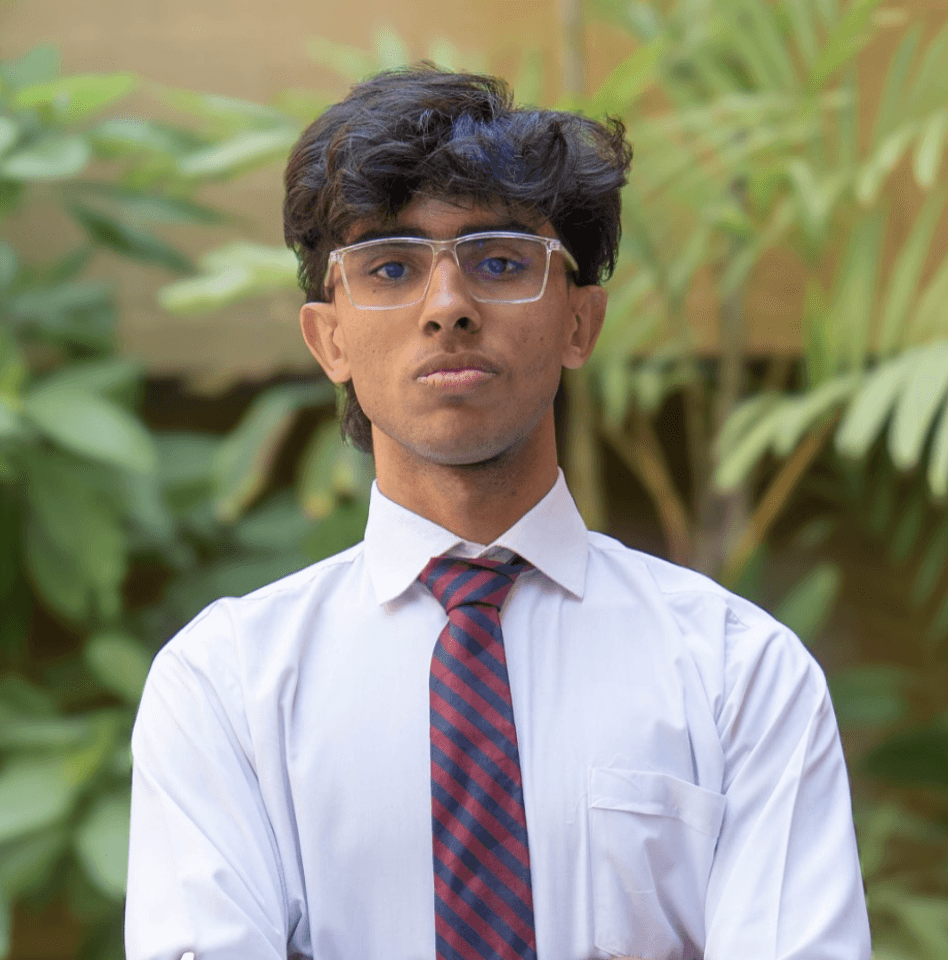
Mubashir Suhail
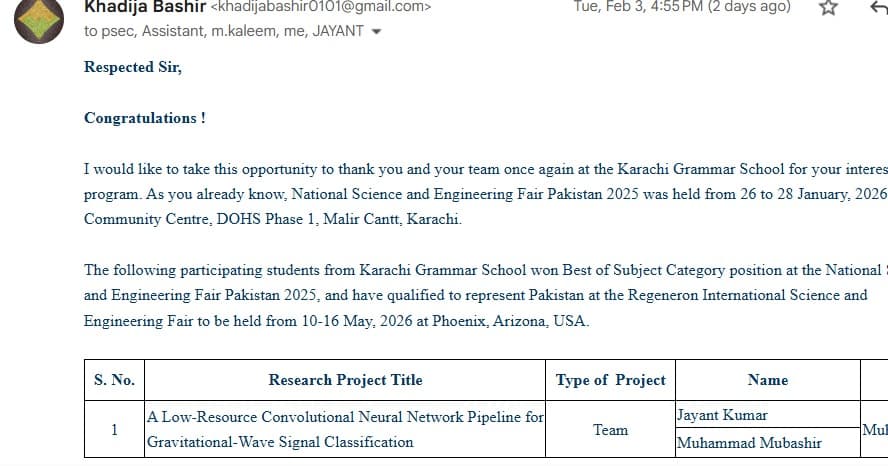
ISEF 2026 Finalist
Physics & Machine Learning

Mubashir Suhail

Karachi Grammar School
Karachi, Pakistan

From zero research experience to ISEF Finalist with groundbreaking astrophysics research

ISEF 2026 Finalist
International Science and Engineering Fair - The world's largest pre-college science competition

Where Mubashir Started

His Background

  • • High school student passionate about physics and computer science
  • • No prior research experience
  • • Deep interest in astrophysics and machine learning
  • • Curious about democratizing access to scientific computing

His Goals

  • • Conduct original research in physics
  • • Compete at international science fairs
  • • Address real-world problems through research
  • • Build a strong profile for top university admissions

His Vision

"I noticed that cutting-edge gravitational-wave research required expensive GPU clusters that most students don't have access to. I wanted to find a way to make this kind of science accessible to anyone with a laptop and curiosity."

— Mubashir, before joining YRI

The Research

Working with his YRI mentor, Mubashir tackled a fundamental problem in astrophysics: how can students and researchers in low-resource environments participate in gravitational-wave machine learning research? His solution combined deep learning with innovative distributed computing.

A Low-Resource Convolutional Neural Network Pipeline for Gravitational-Wave Signal Classification

Problem:

GW detection requires $50,000+/year infrastructure, excluding Global South researchers

Dataset:

G2Net Kaggle dataset - LIGO-Virgo detector strain data

Model:

Lightweight CNN (~92,000 parameters) trained on free Google Colab

Innovation:

P2P-DTF framework enabling 100 laptops to match GPU performance

Novel P2P Distributed Training Framework

Mubashir didn't just identify the problem—he engineered a solution. His P2P-DTF framework enables collaborative training across low-power devices using federated learning principles, 80x gradient compression, and gossip-based synchronization.

100 standard laptops × 150 GFLOPS = 15,000 GFLOPS ≈ 1× NVIDIA V100 GPU

Transforming computational inequality from an insurmountable barrier into a solvable engineering problem

The Outcome

ISEF 2026

International Science and Engineering Fair Finalist

Category:

Physics and Astronomy / Systems Software

Competition Level:

International (1,800+ finalists from 80+ countries)

Project Focus:

Democratizing Gravitational-Wave ML Research

Impact:

Framework applicable to any compute-intensive ML task

"

When I joined YRI, I had passion but no direction. My mentor helped me transform a vague interest in astrophysics into a concrete research project that addresses real inequality in scientific access. The structured approach—from literature review to methodology to writing—gave me skills I'll use for the rest of my career. Becoming an ISEF finalist felt surreal, but looking back, it was the result of months of deliberate, guided work.

Mubashir Suhail
Mubashir Suhail
ISEF 2026 Finalist
Before

Zero research experience, limited resources, no clear path forward

After

ISEF Finalist with original astrophysics research and novel ML framework

Why This Research Matters

$50K+

Annual cost of traditional GW ML infrastructure—now achievable with $0

80×

Gradient compression ratio enabling training on low-bandwidth connections

Global

Framework enables institutions worldwide to participate in frontier research

Ready to Start Your Research Journey?

Join the YRI Fellowship and work with expert mentors to conduct original research, compete at ISEF, and build a profile that stands out.

Apply Now