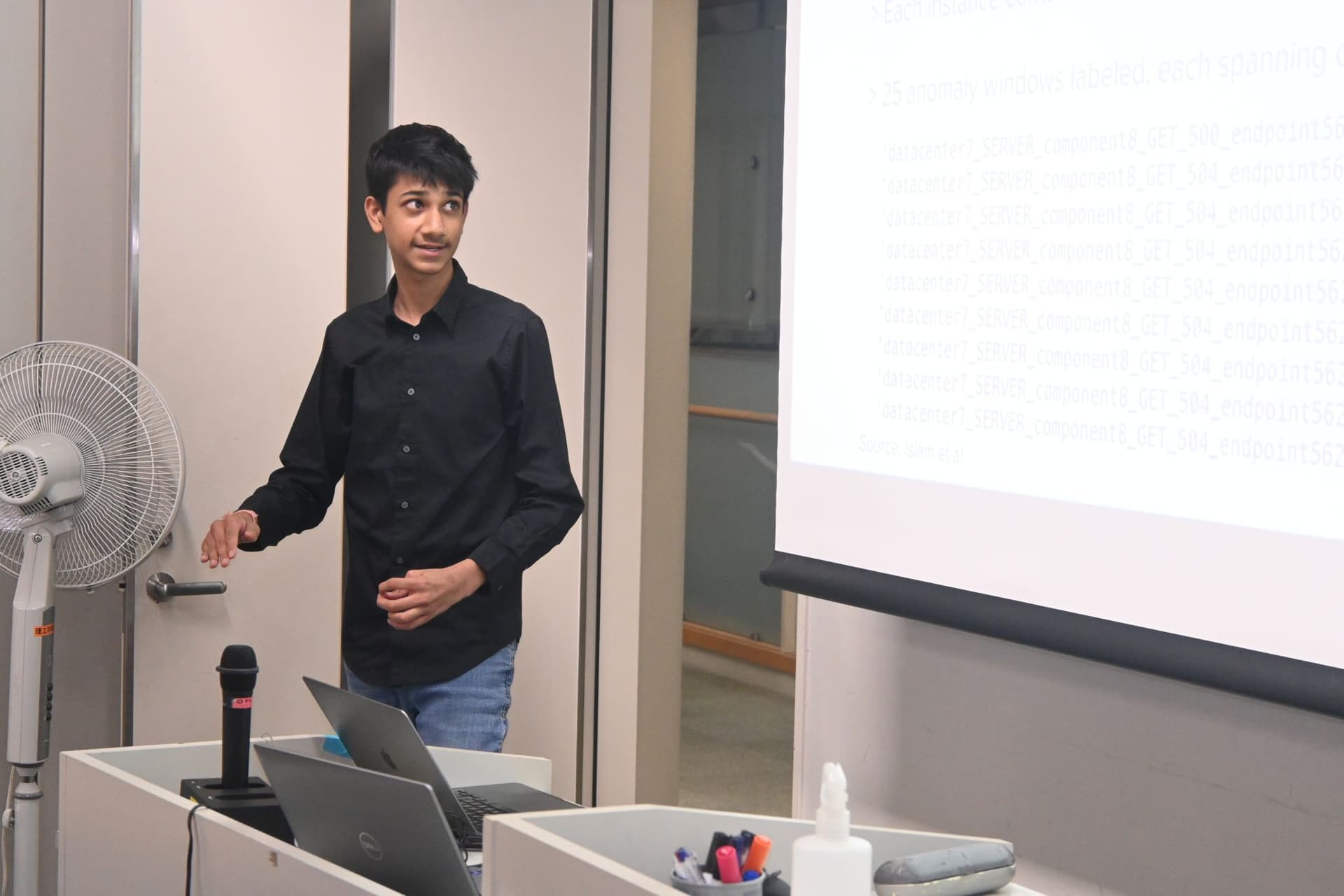
Cupertino High School junior earns top presentation honor at international AI conference for groundbreaking research on cloud system anomaly detection.
Aditya Singla, a junior at Cupertino High School in California, was awarded Best Oral Presentation at the 2026 International Conference on Advances in Artificial Intelligence and Machine Learning (AAIML), an IEEE conference held in Tokyo, Japan from March 20-22, 2026.
Aditya presented his research paper, "A Novel, Multistep Neural Network Approach to Improve Anomaly Detection in Online Operational Status," which introduces a new methodology for detecting system failures in large-scale cloud infrastructure like IBM's Cloud Console.
The Research
Cloud systems power everything from banking apps to social media platforms. When these systems experience anomalies—unexpected failures or disruptions—millions of users can be affected. Current detection methods often miss critical issues or generate too many false alarms.
Aditya's research addresses this challenge with a novel two-step neural network pipeline that progressively filters suspicious data points to identify true anomalies with greater accuracy.
Key Results
Using real telemetry data from IBM's cloud infrastructure (39,365 data points with over 117,000 features), Aditya's approach achieved:
- 16 out of 25 ground truth anomalies successfully detected (up from just 6/25 in prior research)
- Significantly improved true positive to false positive ratio
- A modular, algorithm-agnostic framework that can be adapted for different detection methods
"The multistep approach allows each neural network to focus on a specific task," Aditya explained. "The first network identifies suspicious patterns, while the second network examines those flagged instances more closely to separate real anomalies from false alarms."
From YRI to International Stage
Aditya developed this research through the YRI Fellowship, working one-on-one with a top-tier PhD mentor matched to his field.
"I would like to thank my research mentor, Vamika P., for her guidance," Aditya shared on LinkedIn after his win. "Presenting at an international IEEE conference in Tokyo was surreal. Winning Best Oral Presentation for my session made the trip even more special."
The research journey took Aditya from learning foundational machine learning concepts to implementing sophisticated neural network architectures and optimization algorithms—skills typically developed in graduate-level coursework.
Why This Matters
Anomaly detection in cloud systems is a critical area of computer science research. Companies like Amazon, Google, Microsoft, and Meta all invest heavily in systems that can automatically detect and respond to service disruptions.
Aditya's contribution—improving detection rates from 24% to 64% while maintaining precision—represents a meaningful advancement that could help engineers identify issues before they impact users.
His paper also introduces several techniques that other researchers can adopt:
- A feature scoring algorithm to identify the most predictive variables
- Column and epoch optimization methods for neural network training
- A suspicion ranking algorithm that enables flexible threshold-based filtering
What's Next
Aditya's paper has been accepted for publication in the IEEE conference proceedings, adding a peer-reviewed publication to his portfolio alongside the Best Oral Presentation award.
For high school students interested in AI and machine learning research, Aditya's trajectory demonstrates what's possible: from initial curiosity to international recognition in under a year, with the right mentorship and structured approach.
The YRI Fellowship pairs high school students with PhD-level mentors to conduct original research, publish papers, and compete at top science fairs and conferences. Learn more about the program or apply today.