Ayaan Rustagi
IEEE Published
3rd Place Science Fair
AI & Neuroscience

Ayaan Rustagi

Rouse High School
Georgetown, Texas

Applied astrobiology techniques to detect Alzheimer's from brain scans, achieving 88.9% accuracy

IEEE Published + 3rd Place Science Fair
Cross-domain AI research bridging astrobiology and neuroscience

Where Ayaan Started

His Background

  • • 10th grader at Rouse High School in Georgetown, TX
  • • Interested in AI and its applications in healthcare
  • • Fascinated by the intersection of space science and biology
  • • No prior research or publication experience

His Goals

  • • Use AI to detect motor neuron disease patterns
  • • Publish original research in a peer-reviewed venue
  • • Compete at science fairs with innovative cross-domain research
  • • Bridge multiple scientific disciplines in a single project

The Problem He Wanted to Solve

"I'm interested in using AI to detect motor neuron disease. I wanted to find a way to apply techniques from completely different fields, like astronomy, to solve problems in neuroscience that traditional approaches were missing."

— Ayaan, before joining YRI

The Research

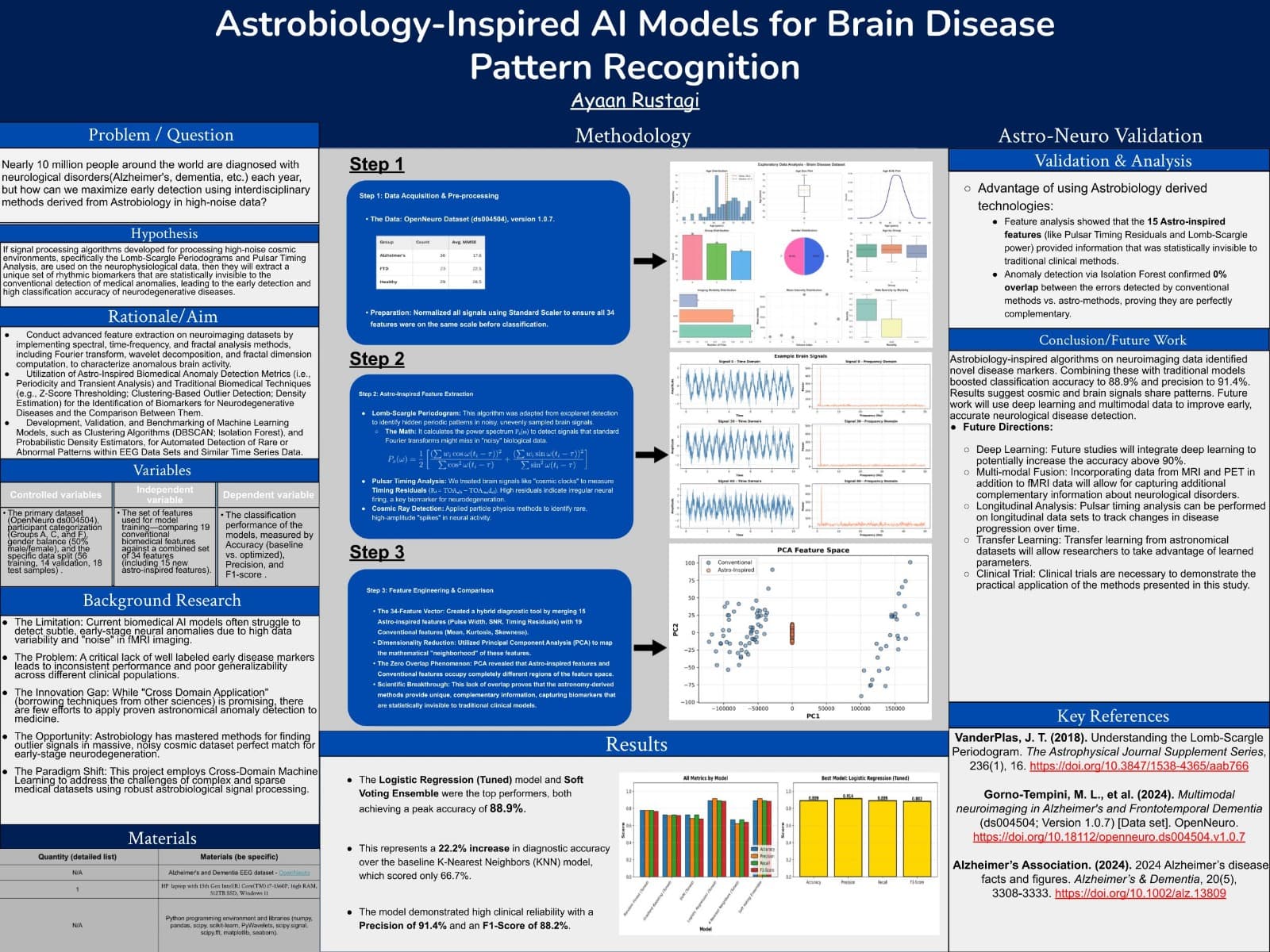
Working with his YRI mentor, Ayaan developed a novel cross-domain approach that applies astrobiology-inspired signal processing techniques to brain disease pattern recognition. By adapting methods used to analyze pulsar timing data in astronomy, he created AI models capable of detecting Alzheimer's patterns in brain scans with remarkable accuracy.

Astrobiology-Inspired AI Models for Brain Disease Pattern Recognition

Problem:

Early detection of neurodegenerative diseases remains challenging with conventional methods

Innovation:

Applied pulsar timing techniques from astronomy to analyze brain scan patterns

Method:

Cross-domain AI models adapting astrobiology signal processing for neuroimaging

Result:

88.9% accuracy in detecting Alzheimer's patterns from brain scans

Cross-Domain Signal Processing

Ayaan's breakthrough insight was recognizing that signal processing techniques used to detect faint pulsar signals in noisy astronomical data could be adapted to identify subtle disease patterns in brain scans. This cross-pollination of methods between astrobiology and neuroscience represents a genuinely novel research direction.

Astrobiology Methods

Pulsar timing and signal detection techniques adapted for biomedical use

AI Classification

Machine learning models trained on cross-domain features

88.9% Accuracy

High-accuracy Alzheimer's detection from brain scan analysis

The Outcome

IEEE Conference + Science Fair

IEEE Published + 3rd Place Science Fair

Publication:

IEEE Conference Paper

Science Fair:

3rd Place Award

Research Field:

AI, Neuroscience, Astrobiology

Publisher:

IEEE

Ayaan Rustagi with his 3rd place science fair award

Ayaan with his 3rd place science fair award

"

I applied astronomy techniques like pulsar timing to detect Alzheimer's from brain scans, achieving 88.9% accuracy. YRI helped me bridge astrobiology and neuroscience, and I won 3rd place at my science fair.

Ayaan Rustagi
Ayaan Rustagi
IEEE Published + 3rd Place Science Fair
Before

10th grader interested in AI and healthcare, no research experience, no publications

After

IEEE-published author, 3rd place science fair winner with cross-domain AI research

Why This Research Matters

88.9%

Accuracy in detecting Alzheimer's patterns using astrobiology-inspired methods

55M+

People living with dementia worldwide who could benefit from earlier detection

Novel

First application of astrobiology signal processing to neurodegenerative disease detection

Ready to Start Your Research Journey?

Join the YRI Fellowship and work with expert mentors to conduct original research, publish in top venues, and present at international conferences.

Apply Now