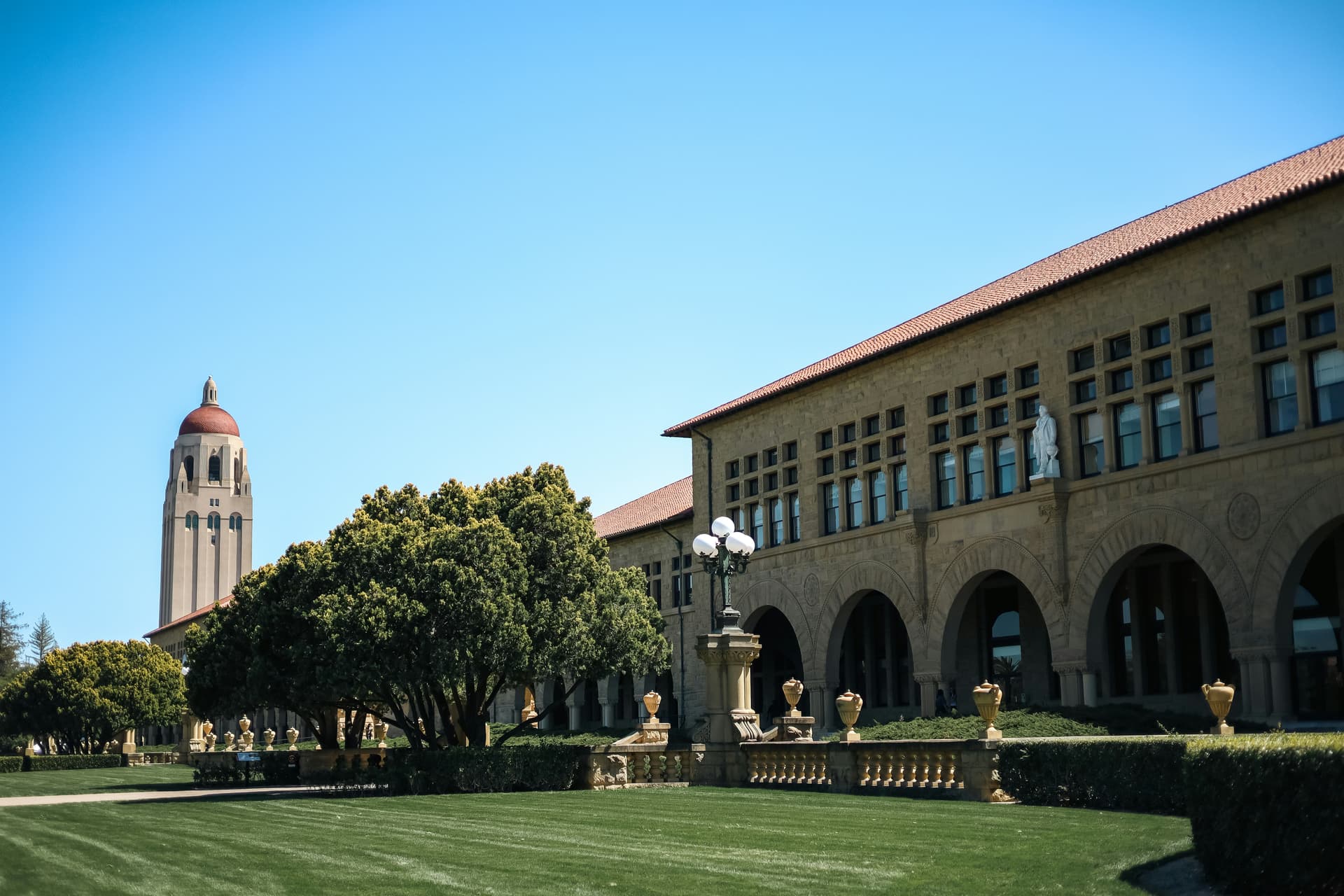
Stanford Pre-Collegiate Summer Institutes is a two-week, live online enrichment course for students in grades 8 to 11; tuition was $3,200 in 2026, courses are ungraded and earn no credit, and students take one course from more than 75. Families searching for a Stanford summer program are often thinking of a second option too: Stanford Summer Session, an eight-week, for-credit quarter on campus for high school sophomores, juniors and seniors, with costs starting at $8,226 for high school commuters and $18,771 for residential students. Neither program publishes an acceptance rate, and Stanford says attending any Stanford program does not increase a student's chances of admission to Stanford.
Every fact below comes from Stanford's own pages for these programs, plus a Stanford Daily report on how admissions treats them. All are linked in the Sources section. YRI Fellowship runs a different kind of program, a research mentorship, and we say that upfront. Where Stanford has not published a number, including 2027 Summer Institutes dates and prices, we say so.
What Stanford Pre-Collegiate Summer Institutes is
Stanford Pre-Collegiate Studies (SPCS) runs enrichment programs for students from grade 1 through grade 12. Its largest high school summer program is the Summer Institutes, sometimes shortened to SPCS or SI.
The current format is fully online. Each course meets live for two hours a day, Monday through Friday, for two weeks, with instructor office hours and asynchronous assignments to prepare for the next class. Stanford lists more than 75 courses each summer, in subjects such as artificial intelligence, creative writing, engineering, mathematics and philosophy, with an average class size of 16. Students come from about 50 states and more than 50 countries.
Courses are not graded and do not earn credit. A student who completes the course receives written feedback from the instructor and a Certificate of Completion. Attendance is strict: students must be on camera with the microphone on at every class, and missing more than one class can cost the certificate. Each student may take only one course per summer.
SPCS also runs several smaller, separate programs that families sometimes group under the same name. Each has its own application.
| SPCS program | What it is |
|---|---|
| Summer Institutes | Two-week online enrichment course, grades 8 to 11 |
| Stanford Summer Humanities Institute | Three-week residential humanities seminars for rising juniors and seniors |
| Stanford University Mathematics Camp (SUMaC) | Intensive advanced mathematics for rising juniors and seniors |
| Stanford AI4ALL | Two-week residential or online AI program with lectures, research projects and mentoring |
| University-Level Online Math and Physics | Online courses that earn Stanford Continuing Studies credit and a transcript |
If your student wants research in medicine or biology, Stanford's separate research program is covered in our Stanford SIMR guide.
What Stanford Summer Session is
Stanford Summer Session is the university's summer quarter, open to high school students alongside college students. High school students choose from more than 130 courses, earn credit and a Stanford transcript, and can live on campus or commute. Stanford says students also get behind-the-scenes visits to labs and research centers and access to more than 20 libraries, sports facilities and maker spaces.
| Summer Institutes | Summer Session | |
|---|---|---|
| Length | 2 weeks | About 8 weeks (June 21 to August 14, 2027) |
| Format | Live online | Residential or commuter, on campus |
| Credit | None, ungraded | Yes, Stanford transcript |
| Courses | One, from 75+ | Residential minimum 8 units; high school commuter minimum 5 units |
| Classmates | Other SPCS students | College students as well |
| Grades | Currently in grades 8 to 11 | Currently sophomore, junior or senior |
| Cost | $3,200 (2026) | From $8,226 commuter, $18,771 residential |
For how these compare with Ivy League summer options, see our guide to the best summer programs at Ivy League schools.
Eligibility
Summer Institutes. Students must be currently in grades 8 to 11 when they apply, and older than 13 and younger than 19 during the program. Many courses are limited to certain grade ranges, which are listed in each course description. International students can apply, and parents or guardians must submit the application with a minor student.
Summer Session. High school students must be a current sophomore, junior or senior at the time of application, at least 16 on June 19, 2027, and no older than 19 by August 15, 2027. Stanford says there are no exceptions to the age limits. Students already admitted to Stanford as first-years cannot attend as high school students.
What it costs, and what aid exists
Summer Institutes, using the 2026 figures, which are the latest posted:
| Item | 2026 amount |
|---|---|
| Tuition | $3,200 |
| Application fee | $65, with fee waivers for those who qualify |
| Course materials | Some courses, not more than $100 |
| Financial aid application fee | $60, with fee waivers for those who qualify |
Financial aid is need-based, can cover part or all of tuition, and is open to both U.S. and international families. Applying for aid does not affect the admissions decision. The aid application runs through the SSS Parents' Financial Statement, and in 2026 it was due one week after the admissions deadline.
Summer Session is priced by the unit. Stanford's cost page lists per-unit tuition of $1,505 and these starting estimates, which include the application fee, program fee, campus health fee and document fee:
| Option | Minimum units | Starting estimate |
|---|---|---|
| High school commuter | 5 | $8,226 |
| Residential (on campus) | 8, typically two or three courses | $18,771 |
| Document fee, first-time students | $250 (included above) | |
| Cardinal Care health insurance, if not waived | $2,936 | |
| Books and supplies, optional estimate | $500 |
Admitted high school students pay a non-refundable $7,000 tuition deposit and a non-refundable program fee to hold their spot. Stanford says its limited tuition grants are for undergraduate and graduate students only, so high school families should plan to pay the full amount. Stanford has not labeled these estimates with a year, and tuition is set annually, so check the calculator before committing.
See how much high school research programs cost for how these prices compare with mentorships and research programs.
Dates and deadlines
Summer Institutes. The 2026 application closed on March 13, 2026 at 11:59 p.m. Pacific, with one round of admissions and decisions in mid-May. The 2026 sessions ran June 15 to June 26 and July 6 to July 17. Stanford has not posted 2027 dates yet. 2027 dates are usually posted in the fall; check the official page.
Summer Session 2027 dates are already posted:
| Milestone | Date |
|---|---|
| Application opens | November 2, 2026 |
| Early Decision deadline | December 15, 2026, 9 p.m. Pacific |
| Early Decision results | January 14, 2027 |
| Regular Decision deadline | January 20, 2027, 9 p.m. Pacific |
| Regular Decision results | February 8, 2027 |
| High school late application deadline | March 1, 2027 (results March 15) |
| International applicants needing an I-20 | April 26, 2027 |
| Check-in | June 19, 2027 |
| Classes | June 21 to August 12, 2027, exams August 13 and 14 |
Stanford notes that the high school program reached a waitlist during the Regular Decision round last year, so the early deadline is the safer choice. Our 2027 summer research program deadlines post puts these next to the selective research programs.
What the application asks for
Summer Institutes: an online form, unofficial transcripts, the application fee, written responses, and a work sample that meets the requirements of each course the student ranks. Students rank up to three courses and are admitted to at most one. Test scores are optional and there is no GPA cutoff. Stanford says the student must write every response, and parents only sign after reviewing.
Summer Session: transcripts and a school profile, one essay of 300 to 400 words chosen from four prompts, English proficiency scores if English is not the student's first language, and an optional list of up to five activities. Stanford says academic excellence is the primary criterion, with no minimum GPA or required number of AP courses.
How selective it is
Stanford does not publish an acceptance rate for the Summer Institutes or for Summer Session. Both describe admission as selective and holistic. Third-party estimates circulate online without citing a source, so we do not repeat them.
Our reading, which is opinion: a strong student with good grades, a careful work sample or essay, and an early application is a credible applicant to either program. Neither is in the same category of selectivity as Stanford undergraduate admission or research programs such as SIMR.
What students get out of it
- Summer Institutes: two weeks of small, discussion-based classes with an expert instructor in a subject most high schools do not teach, written feedback, and a certificate. It is a low-risk way for an eighth or ninth grader to test an interest.
- Summer Session: a full Stanford quarter, college credit, a Stanford transcript, campus life, and access to libraries and facilities. For a student whose school runs out of advanced courses, a strong Stanford grade is useful academic evidence.
Neither is designed to produce original research, a paper or a competition entry. They are courses, and they do what courses do well.
How admissions officers weigh it, frankly
Stanford has been unusually direct. The Stanford Online High School FAQ, run by the same Pre-Collegiate Studies office, says Stanford University does not consider demonstrated interest and that attending any Stanford University program will not increase a student's likelihood of admission. In 2018, Stanford's dean of admission and financial aid told the Stanford Daily that summer programs are treated as an extracurricular activity, with no advantage given in review.
The Summer Institutes FAQ makes the same point more gently. It says the fact that a student participated is not, in itself, the value added to a college application; what matters is how the student learned and grew. As with any extracurricular, it can help a student present as a strong candidate, but it does not guarantee admission.
Opinion: that is a fair and honest framing. The course can be the start of something, an interest that turns into a project, and that project is what a reader remembers. For more on what Stanford's readers look for, see what Stanford admissions wants.
What admissions officers weigh more
Readers at selective colleges see many applications listing a summer course at Stanford or another famous campus. What stands out is a finished result that someone outside the family can verify: a first-author research paper at a peer-reviewed venue, a placement at a regional or state science fair, an ISEF or JSHS run, or a project a mentor can describe in a recommendation letter. Those show what a student did with a question over months.
That is the gap the YRI Fellowship is built to fill. It is 10 weeks, one-on-one with a PhD mentor matched to the student's field, and it ends with the student as first author on a paper submitted to a peer-reviewed IEEE, Springer or Elsevier venue. ISEF and JSHS preparation is included, the mentor writes a letter of recommendation, and mentorship continues at no extra cost until the paper is published. 87% of Fellows publish, 73% place at competitions, and Fellows have been admitted to Stanford, Harvard, Caltech, Johns Hopkins and Brown.
The cost is $2,997, with a three-month payment plan and scholarships considered case by case. Admissions are rolling, so it fits around a two-week Summer Institutes course, and some families do both: Stanford for the classroom experience, YRI for the result that goes on the application. Our comparison of YRI and summer programs and our post on why students waste summers explain the trade-off. Bay Area families can also see local options in our San Francisco Bay Area research programs guide.
Download the YRI Fellowship brochure
The program, the outcomes, the mentors and the tuition, in one PDF you can read with your family.
Related guides
- What Stanford admissions wants
- Stanford SIMR guide
- Best summer programs at Ivy League schools
- Summer research program deadlines for 2027
- YRI vs summer programs
- Research programs for high school students in California
- Are pre-college programs worth it?
- Yale Young Global Scholars guide
Frequently Asked Questions
How much does Stanford Pre-Collegiate Summer Institutes cost?
Tuition was $3,200 in 2026, plus a $65 application fee and up to $100 in course materials for some courses. Need-based financial aid is available to U.S. and international families. 2027 prices have not been posted yet.
Is Stanford Pre-Collegiate Summer Institutes online or in person?
Online. Courses meet live for two hours a day, Monday to Friday, for two weeks, with office hours and assignments outside class. Some other SPCS programs, such as the Summer Humanities Institute, are residential.
Does Stanford Pre-Collegiate give college credit?
No. Summer Institutes courses are ungraded and earn no credit; students receive instructor feedback and a certificate. Stanford Summer Session does give credit and a Stanford transcript.
What is the Stanford Pre-Collegiate Summer Institutes acceptance rate?
Stanford does not publish one. It describes admission as selective and holistic, with no GPA or test score cutoff, and test scores are optional.
How much does Stanford Summer Session cost for high school students?
Stanford's estimates start at $8,226 for a high school commuter taking the minimum 5 units and $18,771 for a residential student taking the minimum 8 units, with tuition at $1,505 per unit. Tuition grants are for college and graduate students only.
When is the Stanford Summer Session deadline for 2027?
Early Decision closes December 15, 2026, Regular Decision closes January 20, 2027, and the high school late deadline is March 1, 2027. Applicants needing an I-20 have until April 26, 2027.
Does attending a Stanford summer program help you get into Stanford?
No. Stanford says it does not consider demonstrated interest and that attending any Stanford program will not increase a student's likelihood of admission. It is weighed like any other extracurricular.
What is a good alternative to Stanford Pre-Collegiate for college applications?
If the goal is a result admissions readers can verify, the YRI Fellowship pairs students one-on-one with a PhD mentor for 10 weeks and ends with a first-author paper submitted to a peer-reviewed IEEE, Springer or Elsevier venue, with ISEF and JSHS preparation included, for $2,997.
Sources
- Stanford Pre-Collegiate Summer Institutes: homepage (online format, grades 8 to 11, 75+ courses, class size, 2026 dates, attendance policy)
- Stanford Pre-Collegiate Summer Institutes: About (two hours daily, ungraded, feedback and certificate)
- Stanford Pre-Collegiate Summer Institutes: Admissions (2026 deadline, decision date, eligibility, application checklist, $65 fee)
- Stanford Pre-Collegiate Summer Institutes: Tuition and Financial Aid (2026 tuition, materials, aid deadlines, aid fee)
- Stanford Pre-Collegiate Summer Institutes: Top Application Questions (college admissions, work samples, test scores optional)
- Stanford Pre-Collegiate Studies: Academic Enrichment Programs (Summer Humanities Institute, SUMaC, AI4ALL, online math and physics)
- Stanford Summer Session: High School (eligibility, age limits, 130+ courses, application requirements)
- Stanford Summer Session: Cost (per-unit tuition, commuter and residential estimates, tuition grants)
- Stanford Summer Session: Tuition and Fees Calculator (document fee, Cardinal Care, books estimate)
- Stanford Summer Session: Dates and Deadlines (2027 application deadlines and academic calendar)
- Stanford Summer Session: Application Process (essay, activities list, selection criteria, $7,000 deposit, waitlist note)
- Stanford Online High School: Admission to Stanford University FAQ (demonstrated interest, Stanford programs and admission)
- Stanford Daily: High school program participants reflect on the value of Stanford's summer programming (dean of admission on how summer programs are weighed)