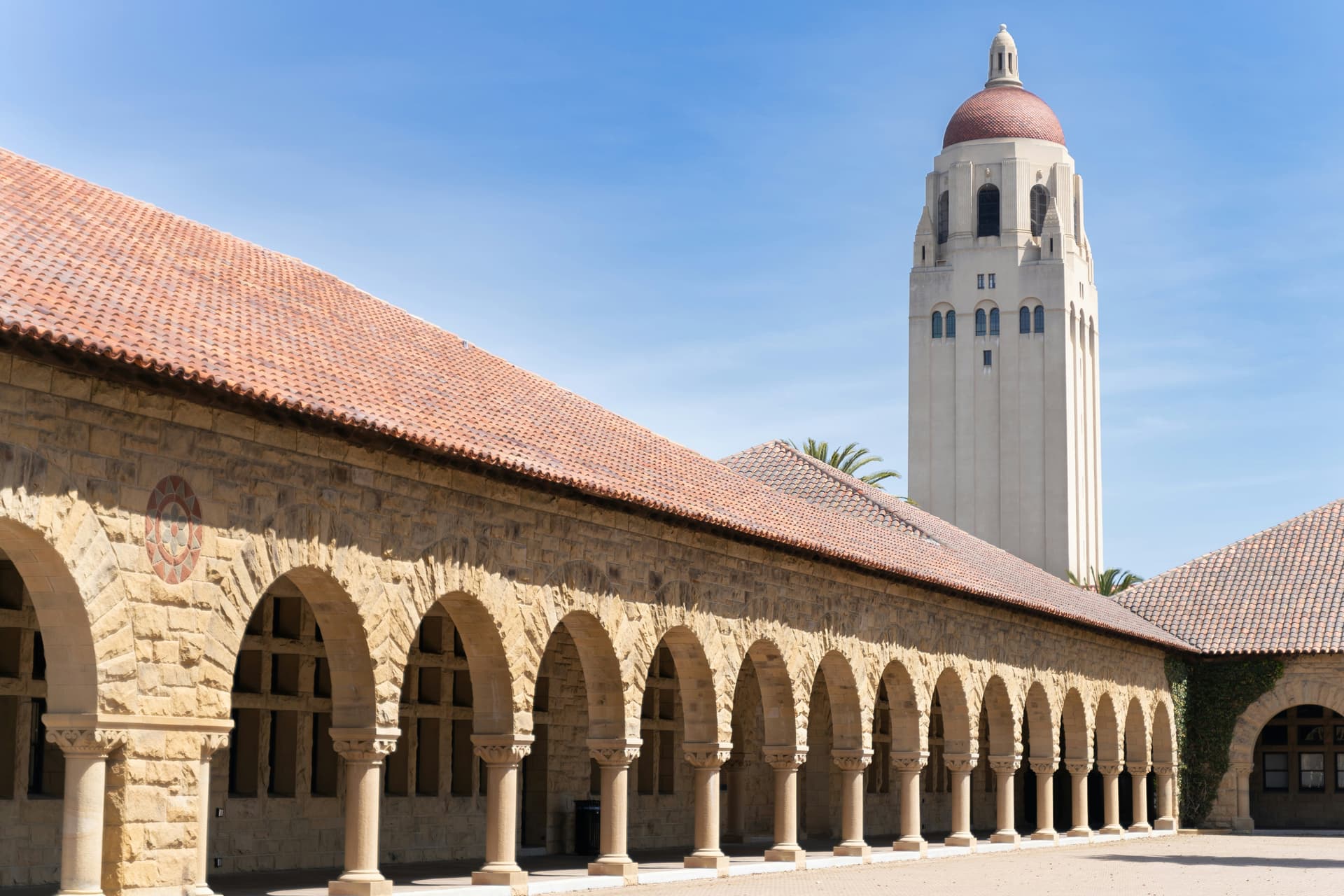
Which Stanford summer program should a high school student apply to? It depends on the goal: SIMR is the only free, lab-based research program and strongly favors Bay Area students; SUMaC is a selective proof-based math camp ($3,750 online, $8,950 residential); the Pre-Collegiate Summer Institutes are two-week online courses for grades 8 to 11 ($3,200); and Stanford Summer Session lets sophomores, juniors and seniors take credit-bearing Stanford courses (from $8,226 commuting). Stanford says plainly that attending any of them does not raise a student's chances of admission to Stanford.
Facts come from Stanford's own program pages as of November 2026, all linked in the Sources section. Most programs have not posted 2027 prices or deadlines yet, so 2026 figures are given where 2027 ones are missing. 2027 dates are usually posted in the fall; check each official page.
The Stanford summer programs at a glance
Stanford runs its high school summer programs through several separate offices: Stanford Medicine (SIMR and SMYSP), Stanford Pre-Collegiate Studies (SUMaC, the Summer Institutes, the Summer Humanities Institute and AI4ALL) and Stanford Summer Session. Each has its own application, fee and deadline.
| Program | Who can apply | Format | Length | Cost (latest posted) | Latest deadline posted |
|---|---|---|---|---|---|
| SIMR (Institutes of Medicine Summer Research Program) | Juniors and seniors, 16+, US citizens or permanent residents living in the US | In person, commute from home | 8 weeks | Free; $50 application fee | Late February 2027 |
| SMYSP (Medical Youth Science Program) | First-generation and low-income juniors | In person on campus, weekdays | About 5 weeks | Not stated on the official page | March 23, 2026 |
| SUMaC (Stanford University Mathematics Camp) | 10th and 11th graders, 15+ | Online or residential | 3 weeks online, 4 weeks residential | $3,750 online, $8,950 residential | February 2, 2026 |
| Pre-Collegiate Summer Institutes | Grades 8 to 11 | Online | 2 weeks | $3,200 | March 13, 2026 |
| Summer Humanities Institute | 10th and 11th graders, 15+ | Residential | 3 weeks | $8,850 | February 2, 2026 |
| Stanford AI4ALL | Current 9th graders | Online or residential | About 2 weeks | $4,120 online, $9,800 residential | February 6, 2026 |
| Stanford Summer Session (high school) | Sophomores, juniors and seniors, ages 16 to 19 | Commuter or residential, for credit | 8 weeks (one quarter) | From $8,226 commuting, from $18,771 residential | December 15, 2026 (Early), January 20, 2027 (Regular) |
Only SIMR places students in a Stanford lab on a research project. The rest are courses or camps. For a wider view of research programs and their odds, see summer research programs for 2027 with deadlines and costs.
Stanford SIMR
The Stanford Institutes of Medicine Summer Research Program is an eight-week program where high school students do basic research on a medically oriented project with Stanford faculty, postdocs, students and researchers. Day-to-day mentors are Stanford graduate students or postdoctoral fellows. Students spend about 40 hours a week on campus, Monday to Friday, attend lectures in the first two weeks, and present a research poster on the last day.
| SIMR 2027 | |
|---|---|
| Eligibility | Juniors or seniors as of fall 2026 (class of 2027 or 2028), at least 16 by the June 2027 start, living in and attending high school in the US, and a US citizen or permanent resident |
| Local preference | Selection "will heavily favor" Bay Area students; non-local students must stay with a family member, not a hotel or rental |
| Cost | No cost to attend; limited need-based stipends |
| Application fee | $50, waived for gross family income under $80,000 |
| Class size | Around 50 students expected |
| Tentative 2027 dates | June 7 to July 29, 2027 |
| Application | SIMR says the 2027 application goes online December 18, 2026, due late February 2027 |
For reference, the 2026 deadline was February 21, 2026, with decisions emailed April 10, 2026. SIMR does not publish an acceptance rate. Our full Stanford SIMR guide covers the institutes, essays and recommendation in detail.
Stanford Medical Youth Science Program
SMYSP is a Stanford Medicine summer program in science and medicine for first-generation and low-income high school juniors. Stanford's page says the 2026 program ran on campus from June 22 to July 26, 2026, with students traveling to the main campus Monday through Friday, and the 2026 application was due March 23, 2026. The official page we could access does not state cost or cohort size, so confirm both directly with the program.
SUMaC: Stanford University Mathematics Camp
SUMaC selects rising juniors and seniors from around the world for advanced mathematics, with topics such as abstract algebra, number theory and algebraic topology. The online and residential versions have the same rigor and content.
| SUMaC (2026 cycle) | |
|---|---|
| Eligibility | In 10th or 11th grade when applying, at least 15 during the program; residential students must be under 18 |
| Seats | 64 online, 40 residential; average class size 16 |
| 2026 dates | Online: June 15 to July 3 or July 6 to 24 (three weeks); residential: June 21 to July 17 (four weeks) |
| Tuition | $3,750 online, $8,950 residential |
| Application fee | $65, fee waivers available |
| Deadline | February 2, 2026; decisions mid-April |
| Application | Take-home admission exam of proof-based problems, essays, one math teacher recommendation, unofficial transcripts |
SUMaC expects experience reading and writing proofs and strong algebra and geometry; number theory and modular arithmetic help. It says it receives many more qualified applicants than it has space for. Students aiming for SUMaC often also look at MIT PRIMES.
Stanford Pre-Collegiate Summer Institutes
The Summer Institutes are single-subject online enrichment courses for students in grades 8 to 11, with more than 75 courses each summer and an average class size of 16. Each session runs two weeks, Monday to Friday. Courses are ungraded and carry no credit.
| Summer Institutes (2026 cycle) | |
|---|---|
| Eligibility | Grades 8 to 11, older than 13 and younger than 19 during the program |
| 2026 sessions | June 15 to 26, or July 6 to 17 |
| Tuition | $3,200, plus up to $100 in course materials |
| Application fee | $65, fee waivers available |
| Deadline | March 13, 2026; decisions mid-May |
| Application | Unofficial transcripts and a ranking of up to three courses |
| Financial aid | Need-based, for domestic and international students; aid application due March 20, 2026, $60 aid fee |
Our Stanford Pre-Collegiate Summer Institutes review goes deeper on value for money.
Stanford Summer Humanities Institute
A three-week residential program for rising juniors and seniors, built around seminars on major questions in the humanities, led by Stanford professors and graduate students. Tuition was $8,850 for 2026 and includes housing, meals, activities and field trips. Sessions ran June 21 to July 10 and July 12 to 31, 2026. Applicants must be in 10th or 11th grade, minors and at least 15. The application asks for transcripts, a humanities or social science school assignment of up to five pages, and one recommendation from an English, history or social science teacher. The 2026 deadline was February 2, 2026, with decisions in mid-April.
Stanford AI4ALL
AI4ALL introduces current 9th graders to artificial intelligence through lectures, hands-on research projects and mentoring. In 2026 the online program ran June 15 to 26 and the residential program July 19 to 31. Tuition is listed at $4,120 online and $9,800 residential, with need-based aid. The 2026 application deadline was February 6, 2026.
Stanford Summer Session for high school students
Summer Session lets high school students take regular Stanford courses alongside college students for a full academic quarter and earn an official Stanford transcript. There are more than 130 courses.
| Summer Session 2027 | |
|---|---|
| Eligibility | Current sophomore, junior or senior; at least 16 on June 19, 2027 and no older than 19 on August 15, 2027 |
| Quarter dates | Instruction June 21 to August 12, 2027; exams August 13 and 14 |
| Tuition | $1,505 per unit |
| High school commuter | Minimum 5 units, from $8,226 |
| Residential | Minimum 8 units, from $18,771; residential space is limited |
| Other costs | $250 one-time document fee; $7,000 nonrefundable tuition deposit once admitted |
| Application | Transcripts, school profile, one essay of 300 to 400 words, optional list of up to five activities, English proficiency if needed |
| Deadlines | Early Decision December 15, 2026; Regular Decision January 20, 2027; high school late application March 1, 2027 |
Stanford says the main criterion is academic excellence, and the high school program reached a waitlist during the Regular Decision round last year. Tuition grants are offered only to undergraduate and graduate students, not high school students.
Does a Stanford summer program help you get into Stanford
No, not by itself, and Stanford says so on its own pages. Stanford Summer Session's FAQ says admission to Summer Session does not guarantee or increase a student's chances of admission to Stanford's degree programs, and that Stanford has no preference for students who attend Stanford-specific summer programs. Stanford Pre-Collegiate Studies says undergraduate admission is separate and independent from its programs, and that taking part is not in itself the value-add to an application.
What counts is what the student learned, built or found. A SIMR poster or a SUMaC proof portfolio is evidence. The Stanford logo is not. Our guide to what Stanford looks for in applicants explains how that evidence is read.
How to be competitive
The odds, frankly
None of these programs publishes an acceptance rate. What is published: SIMR expects around 50 students and favors local applicants, SUMaC has 104 seats across both formats and says qualified applicants far exceed space, and Summer Session reached a waitlist. Plan the summer so that a "no" from Stanford does not leave it empty. Free alternatives are in free research programs for high school students, and an honest look at value is in are pre-college programs worth it.
If you do not get in
SIMR and SUMaC decisions arrive in April. That still leaves a summer and fall before applications, enough time to build what selective colleges look for: a question the student chose, worked on for months, and finished.
Most students admitted to selective colleges with a research profile did that research on their own timeline with a mentor, whether or not they attended a Stanford program. The YRI Fellowship is built for it: ten weeks one on one with a PhD mentor, the student as first author, a paper submitted to IEEE, Springer or Elsevier venues, ISEF and JSHS preparation, and a letter of recommendation from the mentor. Mentorship continues at no extra cost until the paper is published. 87% of Fellows publish and 73% place at competitions, and Fellows have been admitted to Brown, Johns Hopkins, Stanford, Caltech and Harvard. It costs $2,997, less than most paid Stanford options, with a three-month payment plan and case-by-case scholarships. Admissions are rolling, so a student can start in May.
Download the YRI Fellowship brochure
The program, the outcomes, the mentors and the tuition, in one PDF you can read with your family.
Related guides
- Stanford SIMR guide
- Stanford Pre-Collegiate Summer Institutes review
- What Stanford admissions looks for
- Best summer programs at Ivy League schools
- Research programs in the San Francisco Bay Area
- Summer research programs for 2027: deadlines, costs and odds
Frequently Asked Questions
What summer programs does Stanford offer for high school students?
The main official options are SIMR and SMYSP through Stanford Medicine; SUMaC, the Pre-Collegiate Summer Institutes, the Summer Humanities Institute and AI4ALL through Stanford Pre-Collegiate Studies; and Stanford Summer Session, which offers credit-bearing courses. Each has its own application.
Is Stanford SIMR free?
Yes. There is no cost to attend if selected, and limited need-based stipends are available. The application fee is $50, waived for families with gross income under $80,000. Housing is not provided, and selection heavily favors Bay Area students.
How much do Stanford summer programs cost?
Latest posted figures: Summer Institutes $3,200, SUMaC $3,750 online or $8,950 residential, Summer Humanities Institute $8,850, AI4ALL $4,120 online or $9,800 residential, and Summer Session from $8,226 commuting or $18,771 residential. SIMR is free.
Does attending a Stanford summer program help with Stanford admission?
Stanford says no. Its Summer Session FAQ states that attending does not increase a student's chances of admission and that Stanford has no preference for students in its summer programs. Pre-Collegiate Studies says undergraduate admission is separate from its programs.
What is the acceptance rate for Stanford summer programs?
Stanford does not publish acceptance rates for any of them. SIMR expects about 50 students, SUMaC has 64 online and 40 residential seats, and Summer Session's high school program reached a waitlist last year.
When are the 2027 deadlines?
Summer Session's Early Decision deadline is December 15, 2026 and Regular Decision is January 20, 2027. SIMR expects applications due in late February 2027. In 2026, SUMaC and the Humanities Institute closed February 2, AI4ALL February 6 and the Summer Institutes March 13; check each page for 2027 dates.
Can international students attend Stanford summer programs?
SIMR is limited to US citizens and permanent residents living in the US. SUMaC accepts students from around the world, the Summer Institutes offer aid to international students, and Summer Session has an April 26, 2027 deadline for international applicants who need an I-20.
What should I do if I do not get into a Stanford program?
Build the research yourself. The YRI Fellowship pairs a student with a PhD mentor for ten weeks, one on one, and ends with a first-author paper submitted to a peer-reviewed venue plus ISEF and JSHS preparation. 87% of Fellows publish. Admissions are rolling, and the application takes ten minutes with no fee.
Sources
- Stanford SIMR: homepage (eligibility for 2027, Bay Area preference, tentative 2027 dates, application timing)
- Stanford SIMR: Application (2026 deadline, $50 fee, decision date, program dates)
- Stanford SIMR: Frequently Asked Questions (about 50 students, no cost, stipends, fee waiver, housing, mentors, schedule)
- Stanford Medicine: Stanford Medical Youth Science Program (2026 dates, deadline, who it serves)
- Stanford Pre-Collegiate Studies: Academic Enrichment Programs (list of programs and grades)
- Stanford Pre-Collegiate Studies: SUMaC program page (2026 dates, deadline, grades)
- SUMaC: homepage (seats, class size, session formats)
- SUMaC: Admissions (eligibility, admission exam, fee, decision date)
- SUMaC: Tuition and Financial Aid (online and residential tuition)
- Stanford Pre-Collegiate Summer Institutes: homepage (online, grades 8 to 11, 75+ courses, 2026 sessions)
- Stanford Pre-Collegiate Summer Institutes: Admissions (eligibility, deadline, fee, components)
- Stanford Pre-Collegiate Summer Institutes: Tuition and Financial Aid ($3,200, aid deadlines)
- Stanford Pre-Collegiate Studies: Summer Humanities Institute program page (format, 2026 dates, deadline)
- Stanford Summer Humanities Institute: Tuition and Financial Aid ($8,850, inclusions)
- Stanford Summer Humanities Institute: Admissions (eligibility, work sample, recommendation)
- Stanford Pre-Collegiate Studies: Stanford AI4ALL program page (grade, 2026 dates, deadline)
- Stanford AI4ALL: Tuition and Financial Aid
- Stanford Summer Session: High School (eligibility, ages, 130+ courses)
- Stanford Summer Session: Cost (per-unit tuition, commuter and residential minimums)
- Stanford Summer Session: Tuition and Fees Calculator (document fee)
- Stanford Summer Session: Dates and Deadlines (2027 deadlines and quarter dates)
- Stanford Summer Session: Application Process (essay, activities, selection, deposit, waitlist)
- Stanford Summer Session FAQ: Does attending Summer Session improve my chances of admission to Stanford
- Stanford Pre-Collegiate Studies FAQ: Will attending a program improve the chances of getting into Stanford