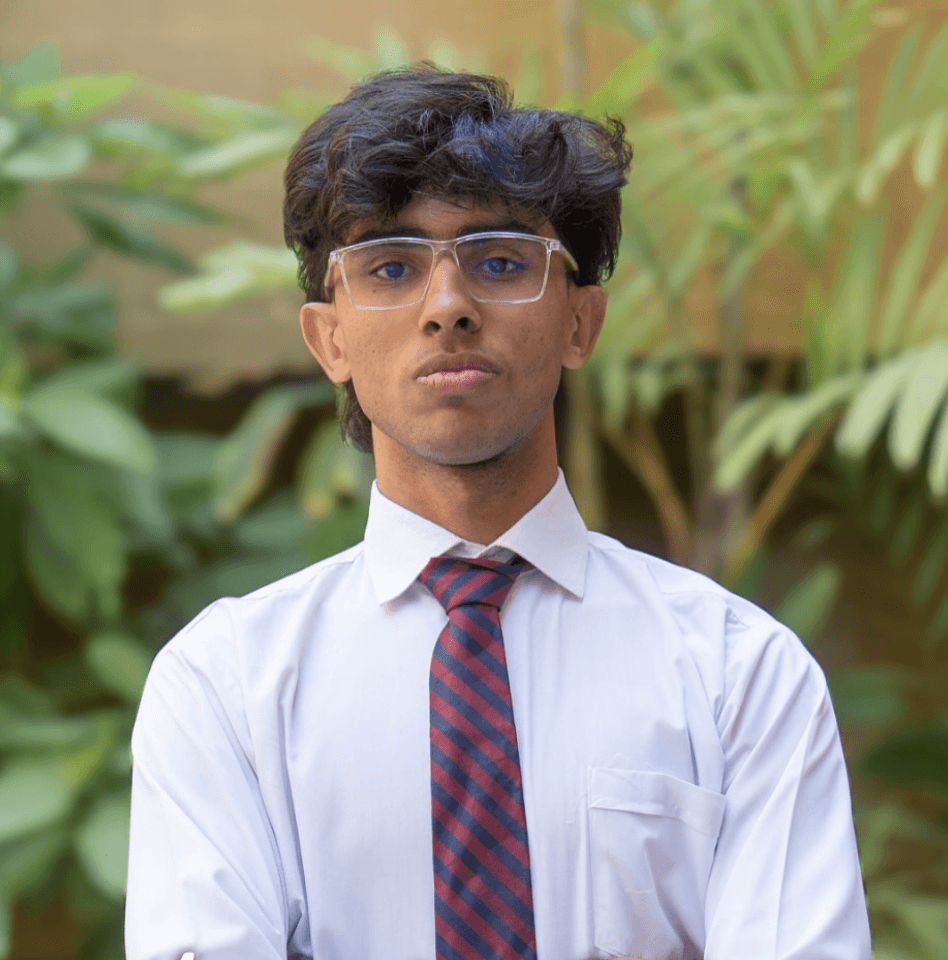
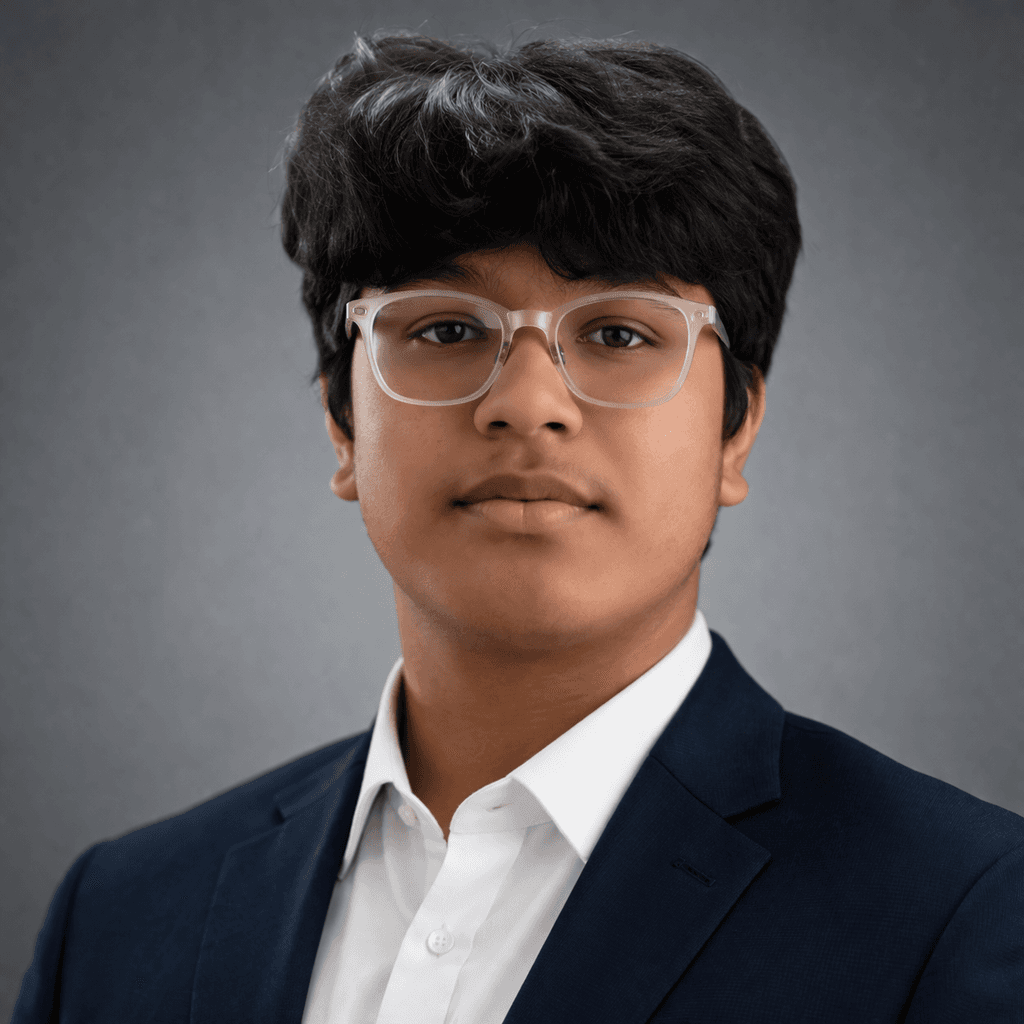
YRI Fellowship students have gone from no research experience to first-author IEEE and Springer papers, Regeneron ISEF 2026, 1st place at a fair held at Princeton University, Best Oral Presentation in Tokyo, and admission to Brown and Johns Hopkins. Below are 12 of those stories, each with the result and a link to the full case study.
Every student here worked one-on-one with a PhD mentor through YRI. Most of them arrived with nothing on their research record. They span ages, countries and fields, from astrophysics and finance to medicine and robotics, which is the point: the YRI Fellowship meets a curious student where they are and helps them finish something that counts.
For the complete record, see Published Work and Student Stories.
What these YRI stories have in common
Before the stories, it helps to know what each Fellow went through. The YRI Fellowship is 10 weeks of one-on-one work with a PhD mentor in the student's own field. Together they find a research question, design the study, collect original data and write a paper. YRI's research writers edit the draft, and the publishing team gets it into a journal or conference. If the journal asks for changes, YRI keeps helping at no extra cost until it is published.
The results across the program: 87% of Fellows publish, and 73% place at science competitions. YRI has worked with more than 1,000 students from over 50 countries.
1. Sadaf S.: from no research experience to Brown and Johns Hopkins
Sadaf joined the summer before senior year with strong grades but no research, no publications and nothing that set her apart. In 10 weeks with her PhD mentor, she wrote a first-author paper that was accepted at an IEEE conference, and it became the centerpiece of her college applications. She was admitted to Brown and Johns Hopkins and selected for UT Austin's $128,000 full-ride scholarship. She then built a venture on the same work, selected for the WUHC Incubator Pitch Competition at Wharton, and was accepted to present new research at the 2027 Yale Undergraduate Research Conference.
Her parents said: "We tried everything: summer programs, college counselors, tutoring. Nothing moved the needle until she joined YRI."
2. Mubashir S.: from zero research to Regeneron ISEF 2026
Mubashir, a student in Karachi with no prior research experience, wanted to detect gravitational waves without the $50,000 or more a year in GPU hardware the field usually needs. He trained a lightweight network on free Google Colab and built a framework that lets 100 standard laptops match a single high-end GPU. He won Best of Subject Category at the National Science and Engineering Fair Pakistan 2025 and qualified to represent Pakistan at Regeneron ISEF 2026 in Phoenix, Arizona.
3. Aditya S.: Best Oral Presentation at IEEE in Tokyo
Aditya was a junior at Cupertino High School with an interest in AI and cloud computing but no research or publication experience. With his YRI mentor he built a neural network that catches failures in large cloud systems, detecting 16 of 25 anomalies against 6 of 25 in earlier research. He presented at IEEE AAIML 2026 in Tokyo, won Best Oral Presentation in his session, and the paper is on IEEE Xplore.
4. Aaryan S.: three papers, three conferences, three countries
Aaryan came to YRI with strong computational skills and no published record. He produced three separate projects in computational biology, from simulating the human interactome to designing a nanocarrier for reprogramming cancer cells. All three were peer reviewed and accepted, at ISMB 2026 in Washington DC, ACM-BCB 2026 in Italy and IWBBIO 2026 in Spain.
5. Ashwajit W.: a Springer paper two months after enrolling
Ashwajit built a spiking neural network model of how the brain consolidates memories, stated three predictions in advance, and confirmed all three across more than 700 simulation runs. Reviewers scored the work 5 out of 5 for novelty and significance. Springer accepted it two months after he enrolled, and it is published in Springer Lecture Notes in Electrical Engineering. He gave a 15-minute talk at BICA 2026 in Merida, Mexico, and his second paper was accepted for a poster at SPIE Medical Imaging 2027 in Vancouver.
6. Suriya D.: accepted at IEEE EMBC as a 9th grader
Suriya, a 9th grader at Doha College, was comfortable with code but had no research, mentorship or science fair experience. He built a machine learning framework that uses eye-tracking measures such as blink rate and fixation time to separate Alzheimer's patients from healthy controls. The work was accepted at IEEE EMBC 2026 in Toronto, the 48th annual conference of the IEEE Engineering in Medicine and Biology Society.
In his words: "I joined YRI as a 9th grader with zero research experience. Within months, my eye-tracking Alzheimer's detection research was accepted at IEEE EMBC."
7. Shaswat S.: 1st place at the Mercer Science & Engineering Fair at Princeton
Shaswat was a 10th grader with a passion for computational biology and no research or publication experience. He built a machine learning pipeline that predicts how stem cells will develop from RNA sequencing data, and identifies the genes that matter most in that decision. He won 1st place at the Mercer Science & Engineering Fair, held at Princeton University.
8. Avyay G.: 1st place and a state qualifier in 9th grade
Avyay started YRI in 9th grade with no prior research. He built AI models that predict when respiratory disease will begin based on air pollution and genetic risk, and found 28% faster disease onset with high pollution exposure. At the Twin Cities Regional Science Fairs he won 1st place in his category, 4 ribbons and a special award, and qualified for the state science fair.
"My research won 1st place at my science fair and I qualified for state. I never imagined achieving that in 9th grade," Avyay said.
9. Rishik A.: defending AI agents, as a 9th grader
Rishik was a 9th grader in North Carolina with cybersecurity certifications and a third-degree black belt. He built a defense that stops AI assistants from being tricked into leaking private data by hidden instructions, and across 150 test cases his active detection cut observed leakage of protected secrets to zero. The paper was accepted at an IEEE conference, and the project made him a semifinalist in the International STEM Research Challenge 2026, selected from 850 applicants worldwide.
10. Elliot W.: a Springer paper as a high school sophomore
Elliot, a sophomore in Sacramento, had sketched a custom-fit helmet idea on his own but had no way to test it and no research training. With his mentor, the idea became an MRI-guided method for designing helmet liners shaped to each person's head, to help prevent head injuries. His paper was accepted at BioMRH 2026 in Glasgow, UK, with proceedings published in Springer's Lecture Notes in Networks and Systems.
11. Karan A.: a finance paper at an international symposium in Riga
Karan, a senior at Delhi Public School, Chandigarh, loved markets but had no research training. He joined YRI in March 2026 and built a graduate-level event study of how sudden geopolitical shocks move Indian aviation stocks against the wider market. Six months after enrolling, his full paper was accepted at the World Finance & Banking Symposium 2026 in Riga, Latvia, and he is listed by name on the conference's accepted-papers index.
12. Raeyaan M.: a muscle-controlled robotic arm, published at IEEE
Raeyaan, an 11th grader at Irvington High School, knew Python and Java but had never done research. He built a low-cost bionic arm from scratch that reads muscle signals from the forearm, classifies gestures with AI and moves in response, reaching 93% accuracy on a $35 Raspberry Pi. He published and presented the work at IEEE WcCST-2026, and it is on IEEE Xplore.
More YRI Fellowship stories worth reading
These twelve are a starting point. A few more that parents often ask about:
- Devansh G., first-author IEEE paper at 14 and founder of a health-AI venture that scaled to 7 figures. Read more.
- Sai T., a 9th grader with zero coding experience who designed a river cleanup system and was accepted at IEEE ICSCSS 2026. Read more.
- Krishik S., a 9th grader who predicted hidden satellite collision risks across 10,460 satellite encounter events. Read more.
- Abhigna N., who built an offline, low-cost AI screening system for rural clinics with lung screening accuracy above 98%. Read more.
You can browse every paper by field in YRI Fellowship published papers, and every competition result in YRI Fellowship science fair results.
FAQ
Are these YRI success stories verifiable?
Yes. Each story names the venue and year, and many papers link to the publisher's own index, such as IEEE Xplore, so anyone can check them. For a full walkthrough, see Is YRI Fellowship legit?
Did these students have research experience before YRI?
Most did not. Sadaf, Mubashir, Aditya, Suriya, Shaswat, Avyay and Raeyaan all started with no prior research.
How long did it take these Fellows to get results?
The Fellowship itself is 10 weeks. Ashwajit went from enrollment to a Springer acceptance in two months, and Karan went from enrollment to an international acceptance in six.
What fields do YRI success stories cover?
All of them. The stories above include AI, astrophysics, medicine, computational biology, neuroscience, biomedical engineering, finance and robotics.
What does the YRI Fellowship cost?
$2,997, or 3 payments of $999, settled only after acceptance. See the tuition page for details.
Write your child's success story
Every story on this page started the same way: with a free application. There are no essays, no research experience is needed, and the decision comes within 48 hours. Tuition is only settled once your child is accepted.
Apply to the YRI Fellowship and let your child's name be the next one on this list. To learn more first, read what YRI is or the YRI Fellowship reviews.